Stamped concrete patterns and colors
Stamped concrete patterns and colors are where a project gets personal. Most homes come down to a few choices, such as ashlar slate, cobblestone or brick, in a color that picks up something already on the house. Here's how to narrow it down.
Updated
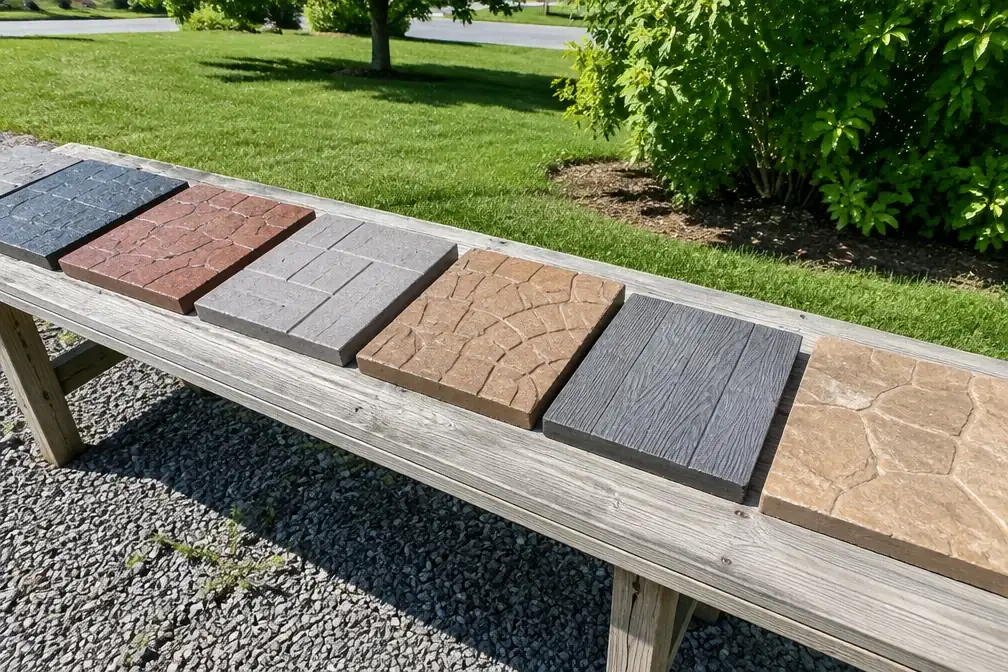
| Pattern | Looks like | Best for |
|---|---|---|
| Ashlar slate | Cut stone in mixed sizes | Most patios and brick homes |
| Roman slate | Larger, softer-edged stones | Big patios |
| Cobblestone | Rounded street stones | Smaller spaces and walkways |
| Herringbone brick | Brick laid at angles | Borders and older homes |
| Flagstone | Irregular natural stones | Curved, informal patios |
| Wood plank | Weathered deck boards | Modern homes and pool decks |
The patterns people choose most
Ashlar slate is the local favorite, and for good reason. Its mix of square and rectangular stones looks at home next to brick, and the pattern is forgiving, as cracks can often hide in its lines. Roman slate is the same idea with larger stones. It suits a bigger patio, where a small pattern would look busy.
Cobblestone recalls the old streets of the city, and it works well in tight spaces. Herringbone brick is a classic choice for a border or a walkway beside a brick house. Flagstone has a loose, natural look that goes well with curves and planting. Wood plank is the newest of these, and it can look right on a modern house or around a pool, with no splinters or rot to worry about.
How the two colors work
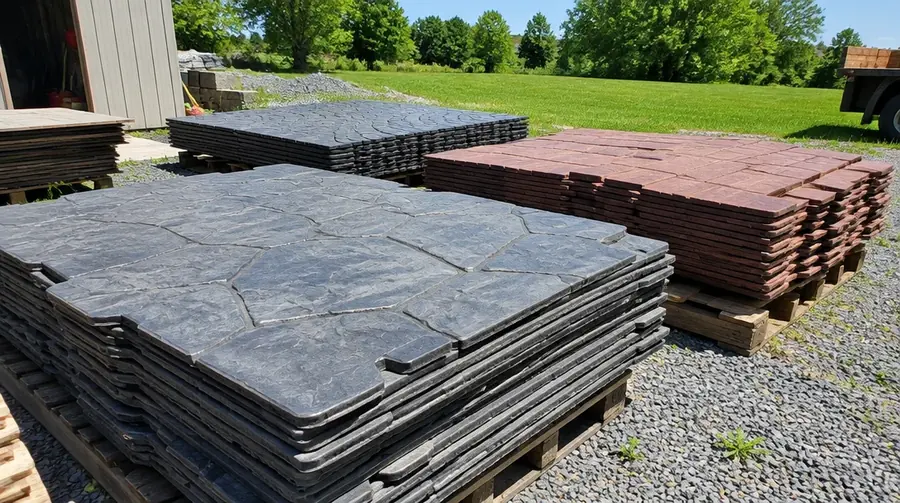
Most stamped concrete has two colors. The base color is mixed into the concrete or cast on top. The release color is a powder or liquid that keeps the mat from sticking, and it stays in the low spots when the slab is washed. So the release shows up in the grooves and texture, a bit like grout and natural shadow.
That contrast sets the mood of the whole slab. A dark release over a light base gives you strong definition, and every stone stands out. A release close to the base color looks softer and more natural. Try a few combinations in the chooser on this page. It's only a guide, but it shows how much the groove color changes the look.
Colors that suit Pittsburgh homes
Look at what's already on the house, including the brick, stone, trim and roof. Pick up one of those colors and you'll be close. These pairings tend to work well here.
| Home | Base color | Groove color |
|---|---|---|
| Red brick | Warm gray or sandstone | Charcoal or dark brown |
| Yellow brick | Sandstone or tan | Dark brown |
| Gray or painted brick | Pewter gray or bluestone | Charcoal |
| Stone homes | Sandstone with walnut | Dark brown |
| Modern siding | Pewter gray | Charcoal, or close to the base |
Light or dark?
Dark colors look rich, but they get very hot in the sun, and they show white efflorescence and scuff marks more readily. Light colors stay cooler and hide dust, though they can show dirt in a shaded yard. Mid tones are the safest choice, and they're also the most forgiving when it comes to color differences between loads.
Colors look deeper with a sealer on, especially a glossy one, and they look paler when the slab is dry. So judge any sample both wet and dry. The look of a patio also changes during the day, so try to see samples in the morning and the afternoon if you can.
Texture matters as much as pattern
Two slabs with the same pattern can feel very different underfoot. Texture is the fine surface detail, such as the grain of slate or the roughness of old stone. A deep texture hides small flaws and gives more grip, but it can be harder to sweep, and it holds on to dirt. A lighter texture is easier on bare feet and furniture, and it suits a pool deck or a covered porch.
Pattern depth counts too. Deep grooves look dramatic, but they can catch chair legs and snow shovels, and tables may wobble. If you'll eat outside often, ask for a shallow joint under the dining area. You can also use a seamless texture, which gives a stone-like surface with no grooves at all, inside a patterned border. That's a good way to keep the look while keeping the table level.
Matching old and new concrete
If you're adding to an existing stamped patio, expect a visible change. Colored concrete varies with each batch, and the old slab has spent years in the sun. It's hard to match exactly, even with the same pattern. There are a few good ways around that. You can separate the new section with a border, so that the change looks intended, or you can apply a tinted sealer or stain to both areas. Sometimes a walkway in a different pattern, in a similar tone, looks better than a near miss.
Common mistakes to avoid
Most regrets come from a few simple choices, and each of them is easy to avoid before the pour.
- Choosing from a small indoor photo, and not from a sample outside
- Picking a dark color for a sunny patio that you will use barefoot
- Using too many colors in one small yard
- Using a pattern too small for a big slab, or too big for a small one
- Asking for a high-gloss sealer on a slope or a pool deck
Borders and accents
A few small touches can make a stamped slab look custom.
- A soldier course of brick around the edge
- A smooth tooled band next to the pattern
- A darker color for the border
- A compass or medallion, if the space can carry it
- Hand-chiseled edges on steps and seat walls
- Hand antiquing to break up repeating tones
Seeing a pattern before you buy
Photos can flatter a pattern, so try to see one in person. Ask a contractor for addresses of past jobs, and look at them in different light. Older slabs are the most useful, as they show how a color has aged. The chooser on this page gives you a rough idea of how pattern and color work together, and it's a good place to narrow down your favorites before a site visit. Our samples will then show you the true color against your own home.
How to choose
Start with the scale of the space, then the pattern, then the color. Keep it simple, as one pattern and two colors are enough for almost any home. Stay away from anything too trendy, as you'll live with it for decades. Then ask to see real samples, not photos, against your own wall. We bring them to the site visit. If you want to price a pattern first, see our stamped concrete cost guide. For the work itself, go to stamped concrete patio.
Common questions
Best color for concrete patio?
A mid-tone gray or sandstone suits most Pittsburgh brick and hides dust well.
More services
- stamped concrete
- stamped concrete patio
- concrete patio contractors
- stamped concrete walkway
- stamped concrete steps and porches
- stamped concrete pool deck
- stamped concrete overlay
- stamped concrete sealing
- stamped concrete repair
- concrete staining
- decorative concrete
- colored concrete
- decorative concrete driveway