How to build a concrete patio that lasts
Knowing how to build a concrete patio helps even if you never pour one, because it shows you what to ask for. Thickness, slope, steel and the joint at the house are what decide whether a patio lasts. Here's what each of those should be in Pittsburgh.
Updated
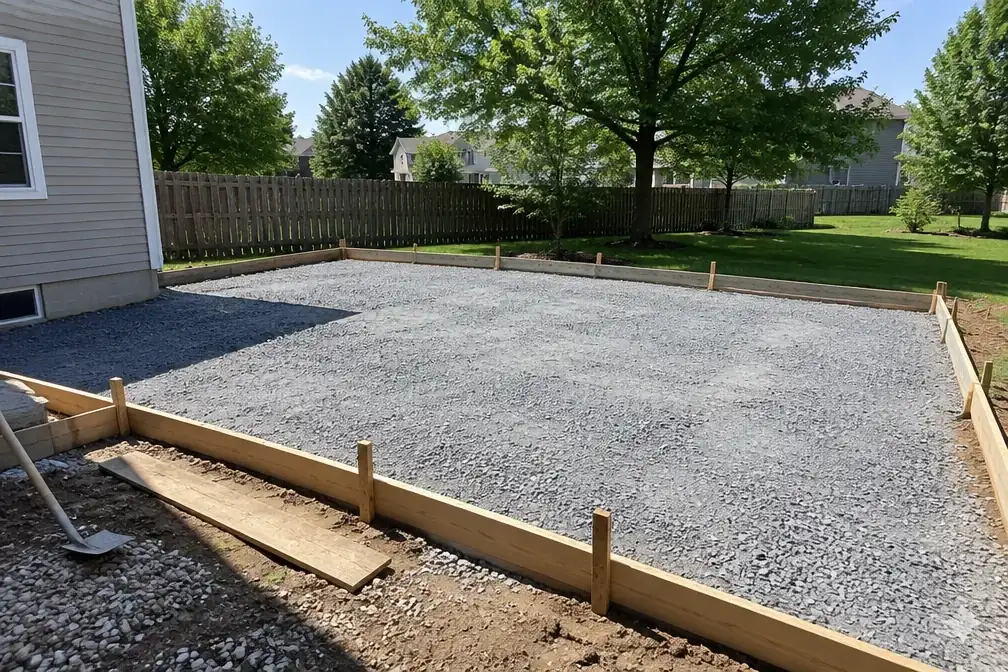
| Detail | What we recommend | Why |
|---|---|---|
| Slab | 4 inches, or 5 for hot tubs | Thick enough for frost and furniture |
| Stone base | 4 inches, compacted | Even support and drainage |
| Steel | Rebar grid or mesh | Holds cracks tight |
| Slope | 1/8 to 1/4 inch per foot | Sheds water from the house |
| Joints | Every 8 to 10 feet | Controls where cracks go |
| At the house | Isolation joint | Lets the slab move on its own |
Start with where the water goes
Before you pick a size or a pattern, go outside in the rain. Watch where water runs off the roof and across the yard. A patio is a large hard surface, and it'll send water somewhere new. If that's toward your foundation or a neighbor's yard, you'll have a problem that no sealer can fix.
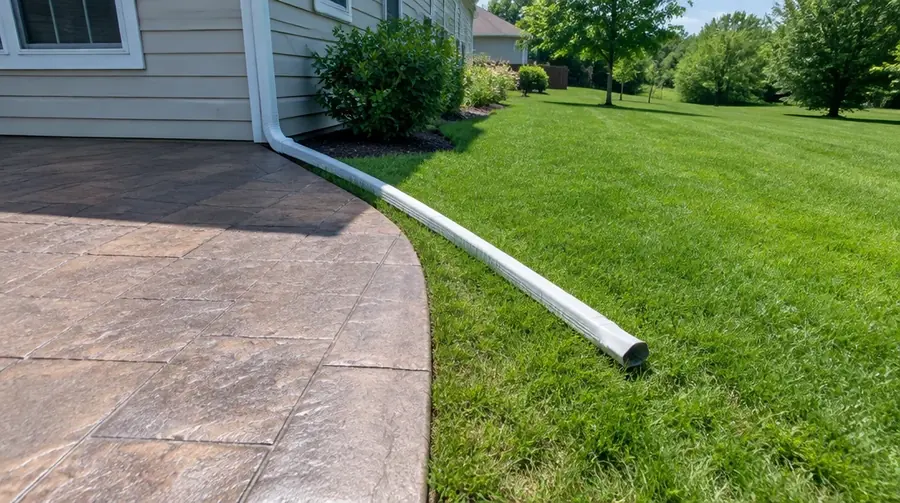
Downspouts often need to be rerouted before a patio goes in, either around the slab or through a pipe beneath it. In a yard that drains toward the house, you may need a small drain or a low swale along the edge. Pittsburgh's clay soil doesn't soak up much water, so don't count on the ground taking it. It's far cheaper to plan this now than to fix it later.
How thick should a patio be?
For most patios, 4 inches of concrete is the standard. It's enough for people, furniture and grills, on a good base. Go to 5 inches or more under a hot tub, an outdoor kitchen or a heavy fireplace, and thicken the slab under any heavy post or wall. Check that the thickness is uniform as well. Many thin spots come from a base that wasn't graded evenly, not from the concrete order.
A hot tub needs special care. A full one can weigh more than 4,000 pounds, so give your contractor the weight and footprint. It's also worth planning the electric line before the pour, as it's far cheaper to put a conduit under a slab than to cut one in later.
Does a patio need rebar?
Strictly speaking, no. A small patio on firm ground can do fine with no steel. But concrete cracks, and steel keeps those cracks tight and level, so that they don't turn into trip hazards. On the clay and fill around Pittsburgh, we recommend a rebar grid or wire mesh on nearly every patio. It adds a dollar or so per square foot, and it's easy to justify on a slab you've paid extra to stamp.
Placement is the key. Steel should sit in the middle of the slab, on chairs or blocks. If it's lying on the stone, it isn't doing much. Fibers in the mix help with early shrinkage cracks, but they don't replace steel.
Meeting the house
Where the slab meets the house is the most common place for trouble. These are the things to get right.
- Leave the slab at least an inch or so below the door threshold
- Keep it below any siding or wood, so that they stay dry
- Use an isolation joint where it touches the wall
- Do not tie the slab to the house unless a designer calls for it
- Allow for loose backfill along the foundation
- Keep window wells and dryer vents clear
Joints and edges
All concrete shrinks, so a joint gives it a place to crack neatly. On a 4-inch slab, joints should be about 8 to 10 feet apart, with panels as close to square as possible. They should be cut to a quarter of the depth, within a day of the pour. On a stamped patio, a good crew hides these joints in the pattern's grooves.
Edges need support too. Soil should be brought up against the slab so that water doesn't wash under it. On a raised patio, the edge will need a wall, and walls bring their own footing and drainage questions. Taller walls may need an engineer and a permit.
Permits and property lines
Rules differ from one town to the next. Many treat a ground-level patio as a simple job, and others limit how much of a lot can be paved. Setbacks from property lines are common, and anything with a roof or a raised deck is likely to need a permit. Call your local zoning office, or ask us to check for you. Make sure any patio is clear of easements and utility lines too, and call 811 before anyone digs.
When to pour
In Pittsburgh, the best months for a patio are May through early October. Stamped work needs a steady temperature and dry weather, since rain and cold both affect the surface and the timing. Early-season dates go quickly, so start getting quotes in winter.
Common mistakes with new patios
These are the problems that most often cause a patio to fail.
- Pouring straight onto soil with no stone base
- Pitching the slab toward the house
- Leaving out joints, or placing them too far apart
- Tying the slab tightly to the foundation
- Leaving downspouts to empty onto the new slab
Next steps
Once you know the basics, the rest is choosing a finish. See our stamped concrete patio page for a patterned slab, or concrete patio contractors for a plain one. If you're ready for a price, the stamped concrete cost guide has typical numbers by size.
Common questions
How thick should a concrete slab be for a patio?
4 inches on compacted stone, or more under a hot tub.
Do concrete patios need rebar?
It isn't strictly required, but we recommend it on Pittsburgh soils.
Should a concrete patio have rebar?
Yes, in most yards here. It keeps cracks tight and level.
Does a patio need rebar?
Small slabs on firm ground can skip it. Most patios here benefit from it.
Does a patio slab need rebar?
It helps, and it's cheap insurance on a stamped slab.
Do you need rebar in a patio slab?
You don't always need it, but it's worth it on clay or fill.
Should a concrete patio be anchored to house foundation?
Usually not. It should float, with an isolation joint at the wall.
Does a patio need drainage?
Every patio needs somewhere for water to go, whether that's a slope or a drain.
Does a patio need edging?
A concrete patio doesn't, as the forms make the edge. Pavers do.
Should a patio be level with the grass?
A little above it is best, so that soil and water stay off the slab.
Do I need a permit to pour a concrete patio?
It depends on your town, and on the size and height. We check for each job.
Does a concrete patio increase property taxes?
Usually not by much, and a ground-level patio is rarely reassessed alone. Ask your county.
More services
- stamped concrete
- stamped concrete patio
- concrete patio contractors
- stamped concrete walkway
- stamped concrete steps and porches
- stamped concrete pool deck
- stamped concrete overlay
- stamped concrete sealing
- stamped concrete repair
- concrete staining
- decorative concrete
- colored concrete
- decorative concrete driveway